South Korean rapper and popular television personality Lee Young Ji has officially stepped forward to address a sudden controversy surrounding her recent social media activity.
In a self-reflective statement shared on her personal Instagram account, the multitalented star apologized to her followers for uploading an ill-timed post that accidentally carried major political implications during a highly sensitive period in South Korea.
The issue quickly gained traction online after fans and casual observers noticed specific visual cues in Lee Young Ji’s social media updates.
Recognizing the gravity of the situation and the speed at which public discourse was evolving, the artist took immediate, decisive action to rectify the misunderstanding.
She not only removed the polarizing images from her page but also went so far as to completely alter her physical appearance in an effort to show her sincerity and neutralize any further public debate.
The Hair Color Dilemma and Its Unintentional Political Connections
The controversy began during the early morning hours of May 31, when Lee Young Ji shared a couple of lighthearted photos on her Instagram Stories to show off a dramatic aesthetic transformation.
In the uploaded images, she was seen wearing a bright red T-shirt while showcasing a fresh, newly dyed red hairstyle.
To complement the visual presentation, she added the song “REDRED” by CORTIS as background music and paired the post with an innocent caption directed at her followers:
“My hair color’s pretty, right? It’s new.”
While the post appeared to be a standard, casual update meant to spark fun engagement with her fanbase, the timing of the upload immediately triggered a wave of concern among netizens.
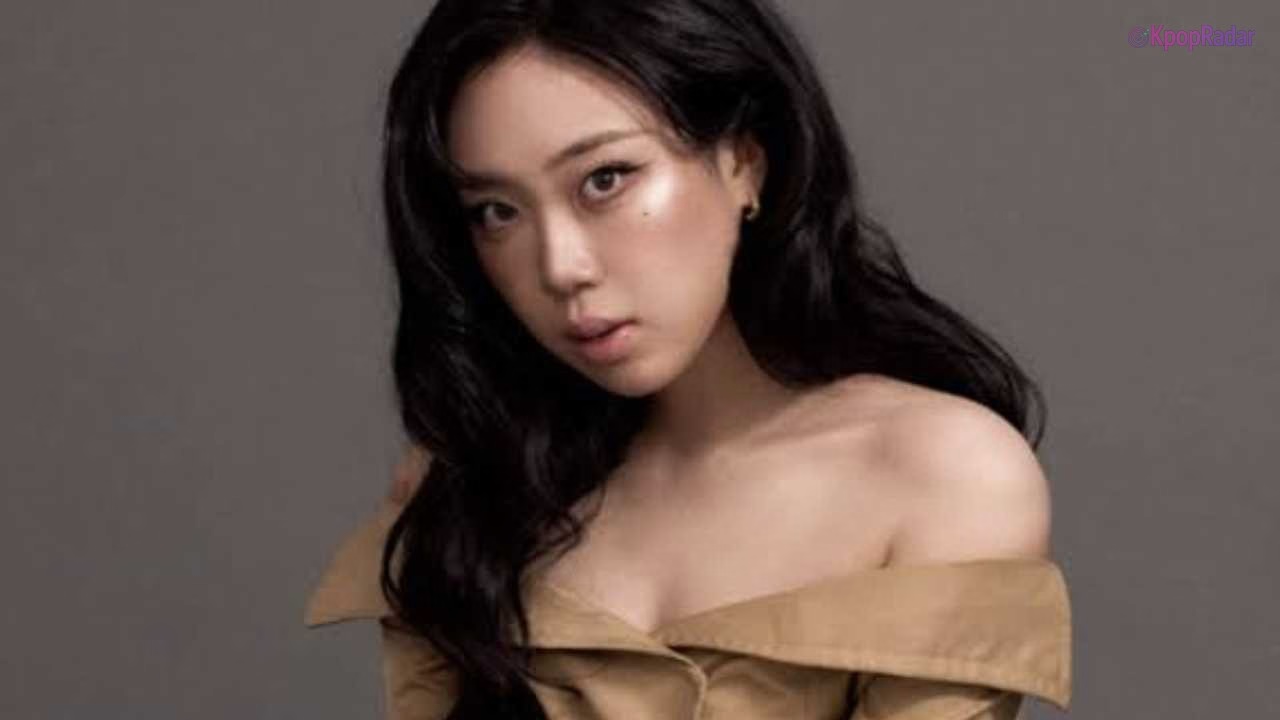
With South Korea’s crucial national elections scheduled for June 3, political sensitivities across the country are exceptionally high.
In South Korean political culture, distinct colors are fiercely tied to specific political parties, with red serving as the primary representative color of a major contending party.
Consequently, many onlookers expressed deep worry that Lee Young Ji’s aggressive emphasis on the color red- spanning her clothing, her hair, and her musical choice- could easily be interpreted by the public as an implicit endorsement or a subtle display of support for a specific political faction.
Immediate Self-Correction and a Detailed Public Apology
Upon receiving a massive influx of direct messages from concerned fans explaining how the imagery looked to the general public, Lee Young Ji immediately scrubbed the controversial stories from her profile.
Later that same evening, she returned to Instagram Stories to share a brand-new selfie- revealing that she had rushed to a salon to completely dye her hair back to a neutral black color.
Alongside the photo, she published a sincere, transparent apology, refusing to hide behind excuses and directly addressing her lack of foresight.
In her open letter to her followers, she explained the delay in her response and expressed her deep remorse for her thoughtless behavior, stating directly:
“You must have been surprised yesterday because I uploaded such an ill-timed story..
Many people let me know via DM.
I felt apologetic and wanted to rectify the situation however I could, so I quickly went and dyed my hair, which is why this explanation is late. I’m sorry.
Even though I was definitely aware that this is a critical time, my eagerness to communicate [with my fans] got ahead of me, and I wasn’t thinking clearly as I haphazardly posted recent photos.
I will not hide behind the cowardly excuse that I was ignorant, and I will learn from this while reflecting [on my mistake].
I apologize for my thoughtless behavior. I hope you have a great day.”
By explicitly acknowledging that she understood the critical nature of the current election season, Lee Young Ji took full accountability for letting her casual desire to chat with fans eclipse her social awareness.
Her drastic choice to instantly dye her hair black resonated with many as a genuine sign of respect for the political neutrality expected of public figures during election cycles, successfully de-escalating the situation before the country heads to the voting booths.