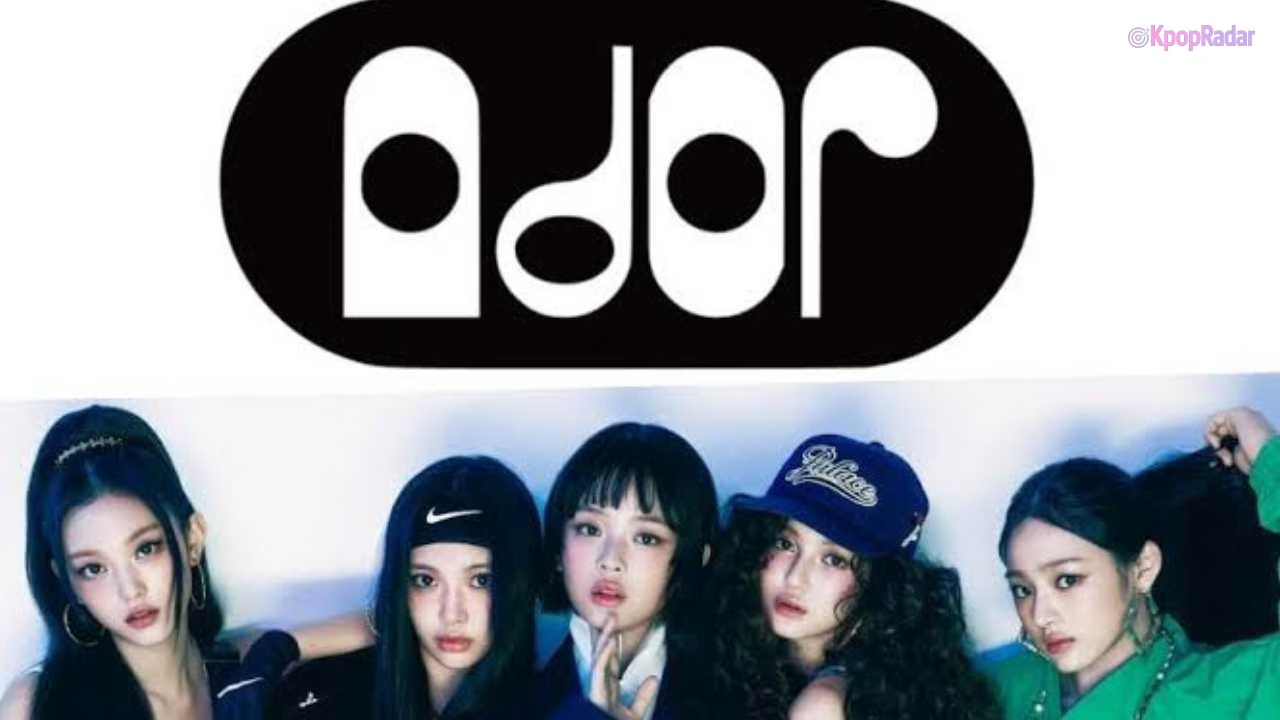
The K-pop industry is currently centered on a significant legal battle as NewJeans, their management label ADOR, and parent company HYBE face a lawsuit over their 2024 hit single, “How Sweet.”
The case, which was brought to light through a report by Billboard on May 8, involves claims of copyright infringement and the unauthorized use of creative intellectual property.
The plaintiffs in the case- songwriters Audrey Armacost, Aidan Rodriguez, Adam Gokcebay, and Michael Campanelli- allege that “How Sweet” bears striking and legally actionable similarities to a demo they created specifically for the group titled “One of a Kind.”
The Origins of the Dispute and Technical Claims of Similarity
The controversy began in early 2024 when Audrey Armacost was approached by her publisher to participate in a “toplining” project for NewJeans.
Toplining is a common industry practice where writers are provided with a pre-existing instrumental track and tasked with creating the lyrics and melody to go over it.
Armacost collaborated with the three other plaintiffs to produce the demo “One of a Kind.”
Despite their efforts, they were informed that their submission was not selected for the final version of the song.
However, upon the release of “How Sweet” in May, the writers felt that their creative contributions had been utilized without their consent or proper attribution.
The lawsuit filed by the four songwriters is grounded in specific technical comparisons between the two tracks.
According to the legal filing, the plaintiffs argue that the first verse of “How Sweet” is “quantitatively and qualitatively similar” to the first verse of their demo, “One of a Kind.”
They point to several structural overlaps that they believe prove infringement.
Both songs are written in a 4/4 meter and are composed in the key of B flat minor.
More critically, the songwriters allege that both tracks feature a topline containing an approximately eight-bar, 31-note melodic sequence consisting of four distinct series.
These specific musical markers form the backbone of the plaintiffs’ argument that their melody was essentially “lifted” and integrated into the final production of “How Sweet” after they were told their work was rejected.
ADOR’s Defense and the Industry Impact
In response to the growing public and legal pressure, ADOR issued a comprehensive statement on May 9, 2025, to clarify their position and defend the artistic integrity of the track.
The agency explained that they had conducted a thorough internal review and consulted with BANA (Beasts And Natives Alike), the production house responsible for the composition and overall production of “How Sweet.”
Regarding the outcome of this consultation, ADOR stated that
“BANA’s position is that there is no plagiarism” in the song’s creation.
The agency further emphasized their commitment to fighting the claims in court, noting that:
“ADOR and the NewJeans members also plan to respond based on BANA’s position.”
By aligning themselves directly with the producers, ADOR is signaling a unified front against the allegations, maintaining that the creative process was entirely original and independent of the plaintiffs’ demo submission.
This case highlights the complexities of the modern music production landscape, particularly the “pitching” process where dozens of demos are often submitted for a single K-pop comeback.
The legal distinction between common musical tropes and protected intellectual property is often thin, making this a landmark case for songwriters and agencies alike.
If the court finds merit in the plaintiffs’ claims, it could change how labels handle rejected submissions and how they document the evolution of a song from an instrumental track to a finished pop hit.
As the legal proceedings move forward, NewJeans remains one of the most successful acts in the industry, though this lawsuit adds a layer of complexity to their recent promotional cycle.
Fans and industry analysts are now waiting to see how the court interprets the 31-note sequence mentioned in the filing.
For now, ADOR and HYBE remain steadfast in their denial, asserting that “How Sweet” is an original work that does not infringe upon the rights of the four songwriters involved in the “One of a Kind” demo.